'It was the best of times, it was the worst of times'
When the development of Troy Town was underway, Britain, and Europe, were undergoing rapid change.
In 1786, when the building of Troy Town began, King George III was not yet half way through his long reign. He had begun to suffer from the periods of 'madness' that would eventually incapacitate him permanently and lead to the establishment of the Regency.
Men still wore knee-breeches and stockings. Powdered hair and wigs became less popular after a hair powder tax was introduced in 1795. Women's fashions were becoming simpler, as they moved towards the high-waisted styles associated with the Regency period.

However, the mood in Britain changed in 1792 with the execution of the French King and Queen and the Reign of Terror, and the declaration of war on Austria and Prussia. Early in 1793 Britain joined the war, which was to continue, with short intervals, until 1815.
English agriculture had been increasing in efficiency and productivity for the last two centuries. Usually the country could feed itself. In the 1790s, however, a series of bad harvests, combined with rising population and the outbreak of war in 1793, led to rising food prices and hardship for many.

The Industrial Revolution was underway in the United Kingdom, with mechanisation, powered by water and steam, being introduced to manufacturing processes, initially in the cotton and woollen cloth industries.
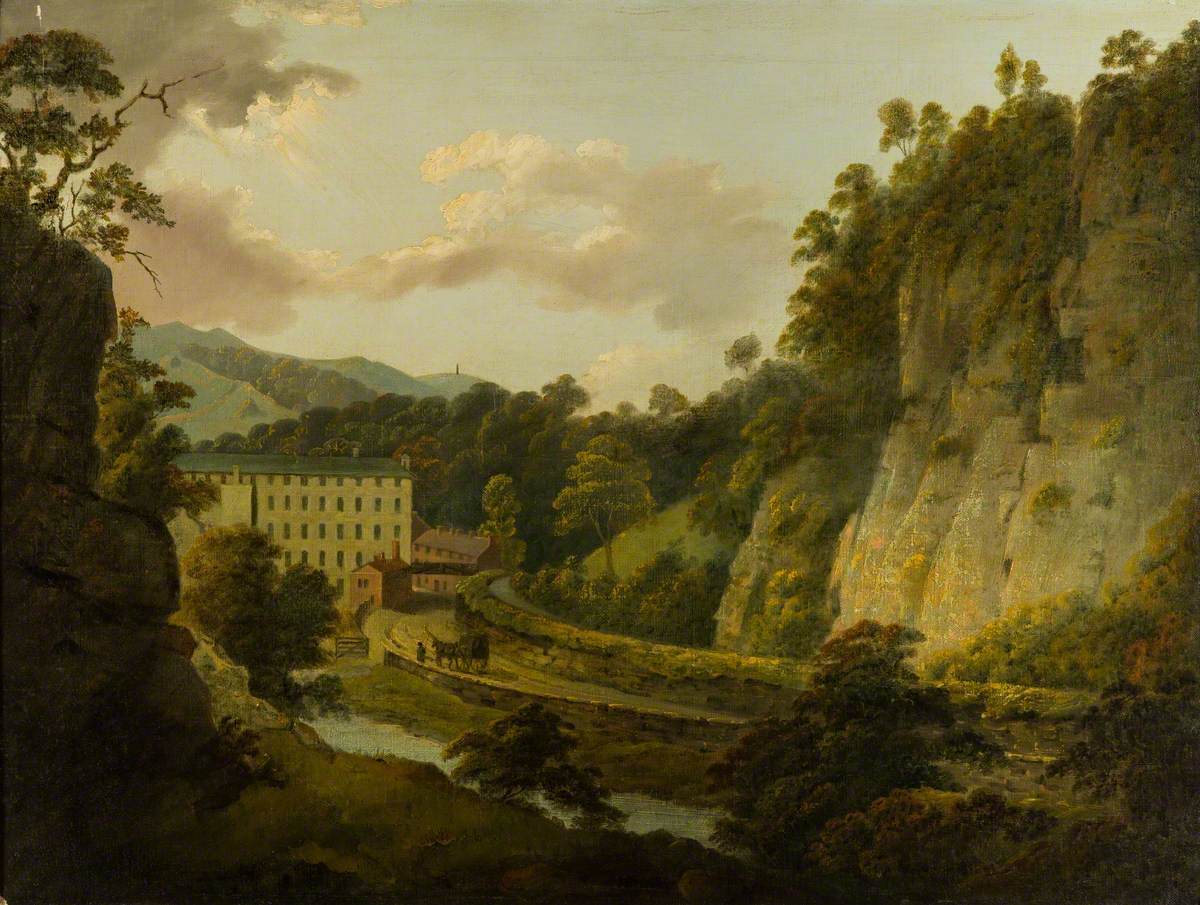
Arkwright's Mills
Joseph Wright of Derby (1734–1797)
The consequence for the workforce in those industries was long hours of work in factories. Where, as in the case of Arkwright's mills, the factory was established in the countryside, a the mill owner would have to provide housing for his workers.
Elsewhere, many workers living in poor quality housing in overcrowded and insanitary towns.
Canals were built, the most ambitious construction projects undertaken in Britain since the Roman era. They enabled cheaper and faster distribution of raw materials and manufactured goods, whether imported or domestic. Consumers benefited from access to a wider range of goods.

The Barton Aqueduct: the Bridgewater Canal crossing the River Irwell, Lancashire.
The American Revolutionary War had ended in 1783, with the colonies lost and Britain left with a greatly increased National Debt. William Pitt the Younger, first as Chancellor of the Exchequer, then as Prime Minister, sought to increase government revenue by levying taxes not only on bricks but on a range of items including horses, hackney carriages, ribbons and candles.
The British Empire still included Canada and the West Indies. The first convict fleet sailed for Botany Bay in 1787. The first free settlers arrived in Australia in 1793.
The East India Company ruled its Indian territories from its bases at Bombay, Calcutta and Madras. From 1784 this was under the authority of a government appointed Board of Control.
East India House, Leadenhall Street, City of London, 1726-1786
Overseas trade was expanding, and this, with Britain's growing industrial power, created the wealth which enabled Britain to maintain an Army and Navy and pay subsidies to Continental allies, to bring about the downfall of Napoleon.
British ships and merchants participated in the Transatlantic slave trade, and in ownership of slaves. In his will, made in 1797, John Boyd of Danson referred to his 'plantations or estates with the slaves... in the Island of St Christopher'.
Robert Marsham, 2nd Baron Romney of Maidstone, acquired estates in St Kitts through his marriage to the daughter of a plantation owner.
Waxham Graham, father of Jacob Cazeneuve Troy's second wife, had lived in Jamaica and may have been a slaveowner.
The Abolition movement was gathering strength, led by politicians such as William Wilberforce and industrialists such as Josiah Wedgwood. People in Kent were involved in the anti-slavery movement.
Next: John Hooker, House Carpenter
_____________________________
See my historical mystery fiction on Amazon Kindle here


Comments
Post a Comment